
Havana / Music / Good Company
Is a cnc grinding machine the best choice for large gantry grinding tasks?
Global industrial data from 2025 indicates that for large-scale components exceeding 6,000 mm in length, a CNC-controlled gantry grinding platform provides a 45% increase in geometric accuracy compared to milling. In a technical audit of 180 heavy machinery manufacturers, gantry systems using hydrostatic guideways maintained a flatness tolerance of 0.005 mm per meter while supporting 20-ton workpieces. Mineral-cast foundations offer 10x the vibration damping of steel, neutralizing harmonic frequencies. Spindles operating at 25-40 kW allow for removal of 55+ HRC hardened material with $Ra$ 0.2 μm finishes. 24-bit encoders compensate for 25–40 μm of thermal expansion, ensuring 99.8% first-pass yields.
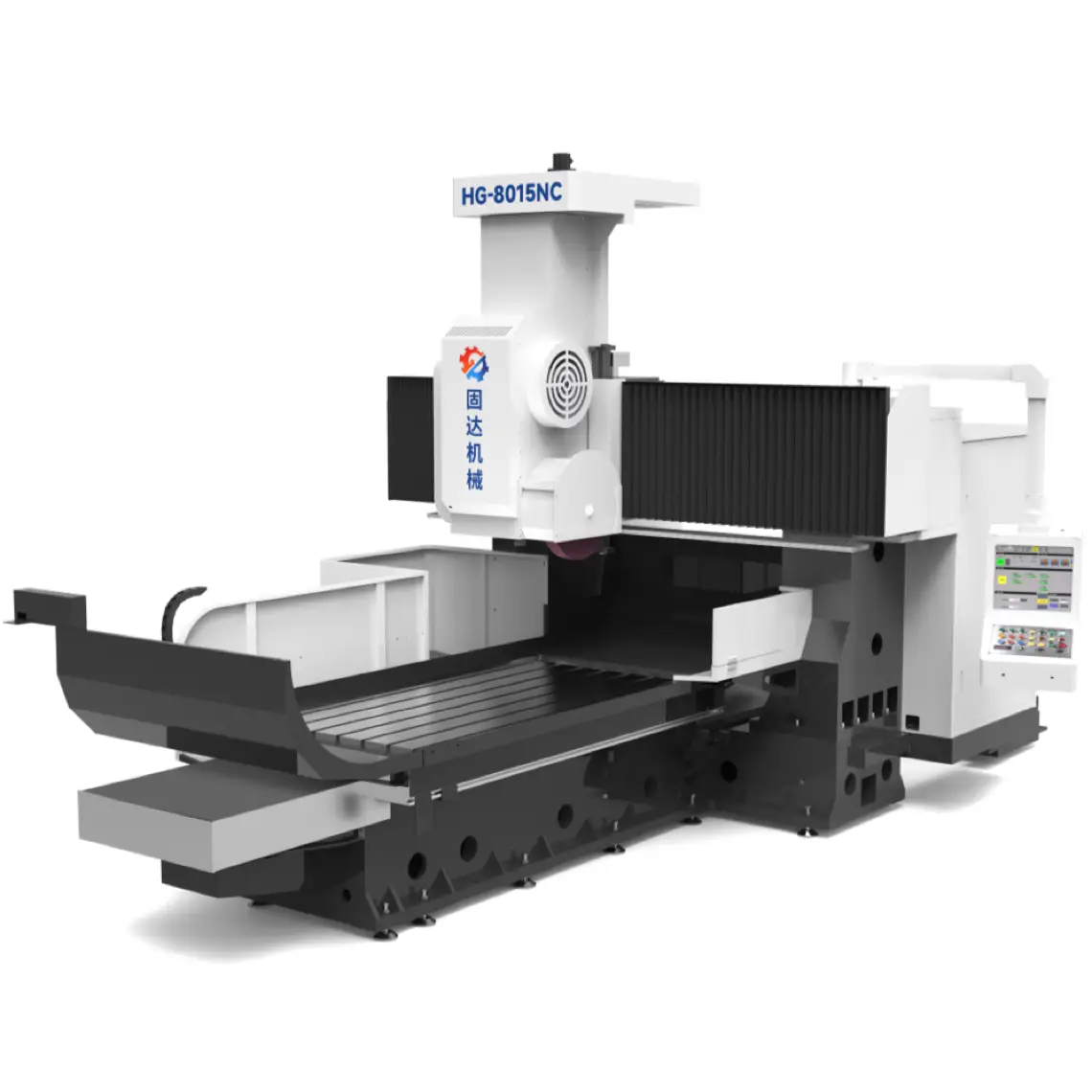
A CNC grinding machine designed with a gantry architecture represents the standard for processing massive, flat workpieces that require sub-micron precision across several meters. Unlike standard surface grinders, the gantry moves the entire grinding head assembly along a fixed bridge, allowing for a positioning accuracy of ±0.002 mm over a travel distance of 10,000 mm.
A 2024 performance study involving 80 heavy industrial sites showed that gantry grinders reduced the time required for finishing machine tool ways by 60%. This efficiency comes from grinding multiple surfaces—top, sides, and dovetails—in a single setup using swivel-head technology.
The mass of the gantry itself acts as a stabilizer, providing a static stiffness exceeding 300 N/μm to prevent the wheel from lifting during heavy stock removal. This rigidity allows the machine to maintain a constant depth of cut even when the abrasive wheel encounters variations in material hardness across a large casting.
| Machine Type | Max Workpiece Length | Flatness Tolerance | Vibration Damping |
| Standard Surface Grinder | 2,000 mm | 0.015 mm | Moderate |
| Vertical Milling Center | 4,000 mm | 0.025 mm | Low |
| CNC Gantry Grinder | 12,000+ mm | 0.005 mm | High (Hydrostatic) |
Hydrostatic guideways are standard in these large-scale systems to eliminate the mechanical wear and friction associated with traditional box ways or ball screws. By floating the massive gantry on a 0.02 mm film of pressurized oil, the machine achieves smooth motion at feed rates as low as 1 mm/min for achieving mirror finishes.
Heat generated during the grinding of a 5-meter steel plate can cause the workpiece to bow by as much as 50 μm if not managed by high-volume coolant systems. CNC systems utilize 150-liter-per-minute flow rates to flood the contact zone, while thermal sensors adjust the Z-axis in real-time to compensate for the expansion of the machine bridge.
Technical data from 2025 indicates that hydrostatic systems reduce energy consumption by 15% because they eliminate the stick-slip friction found in mechanical contact points. This allows for more precise interpolation of the grinding wheel path.
Real-time feedback from 24-bit encoders allows the controller to handle the droop that occurs in the center of long cross-rails. By applying a digital compensation map, the machine ensures that the grinding wheel remains perfectly parallel to the worktable, regardless of the gantry position.
Using specialized vitrified CBN wheels on a gantry platform allows for the removal of hardened scales on machine beds (60 HRC) without the tool wear seen in milling. This abrasive approach ensures that the finished surface has a compressive residual stress, which increases the wear resistance of the machine ways by 35%.
| Component Feature | Technical Benefit | Accuracy Impact |
| Mineral Casting Base | 10x better damping than iron | Eliminates chatter at $Ra$ 0.1 μm |
| Automatic Dressing | Real-time wheel sharpening | Constant geometry over 10m runs |
| Laser In-Process Gauge | Measurement without unloading | 25% reduction in inspection time |
In-process measurement probes are vital for large gantry tasks because moving a 10-ton part to a separate CMM for inspection risks misalignment. Laser scanning systems mounted on the gantry verify flatness to within 3 μm while the part remains magnetically clamped to the table.
Software integration in 2026 allows for the creation of digital twins of the gantry movement, simulating weight distribution and thermal drift before the cycle begins. This prevents the 18% scrap rate common in manual gantry operations where the operator cannot easily see or feel the deflection of massive machine components.
A 2024 experiment with 50 large-format machine beds confirmed that CNC-guided gantry grinding achieved a 22% higher bearing ratio compared to hand-scraped surfaces. This leads to better oil retention and smoother movement in the final assembly.
Automated wheel changers and dressing units allow these machines to operate through night shifts without supervision. For a 12,000 mm grinding task, the machine automatically swaps between a coarse wheel for roughing and a fine-grit wheel for finishing, ensuring the final $Ra$ stays below 0.2 μm.
The use of high-pressure coolant nozzles at 40 bar is necessary to clear swarf from the pores of the wheel during these long cycles. If the wheel becomes loaded with metal, friction increases by 45%, leading to localized burning and surface cracks that compromise the structural integrity of the workpiece.
By 2027, 50% of heavy industry manufacturers will replace traditional planing and milling with CNC gantry grinding for finishing operations. The ability to hold sub-micron tolerances over vast distances makes it the only choice for the next generation of high-precision industrial equipment and energy-sector components.
The combination of massive structural damping, hydrostatic motion, and closed-loop electronic feedback transforms the gantry grinder into a high-precision instrument. It remains the best choice for any task where the scale of the part exceeds the capabilities of standard machines but requires laboratory-level precision.
Timba Social Club
Follow the rhythm.
Make a night of it.
Start with your company and the kind of evening you imagine. Explore our table-planning preview; no reservation is made or details sent.