
Havana / Music / Good Company
Which Mini Bike Is Best for Backyard and Trail Riding?
When choosing an ideal model for backyard and trail cycling, the adaptability of the power system is the primary consideration. A mini bike equipped with a 196cc four-stroke engine can provide approximately 6.5 horsepower in power output, with a peak torque of 8.7 N · m, which is sufficient to handle slopes of 15 degrees or less. Its fuel efficiency remains at around 2.5 liters per 100 kilometers, which means that a single 10-liter refueling can last for more than 4 hours. According to the 2023 North American Outdoor Sports Equipment Survey Report, 73% of users believe that models with power ranging from 5 to 7 horsepower best balance the needs of backyard entertainment and light off-rotting. This power configuration ensures seamless switching from flat courtyards to rough dirt roads, and the speed range is adjustable between 5 kilometers per hour and 30 kilometers per hour.
The performance of the vehicle suspension system directly determines the riding comfort and stability. The best choice is often equipped with a front-mounted hydraulic front fork and a rear dual shock absorber, with travel lengths of 100mm and 80mm respectively. It can effectively absorb about 70% of ground impacts, ensuring that the vehicle body vibration is controlled within the human comfort threshold on bumpy roads with an amplitude of up to 50mm. For instance, in a renowned mountain endurance race in 2022, a mini bike modified with a suspension similar to that completed a 50-kilometer course. The failure rate of its key components was reduced by 40% compared to the base model. This was attributed to the fact that its suspension could maintain a performance degradation rate of less than 5% even under high-frequency vibrations (at frequencies of 3 to 5 Hertz).
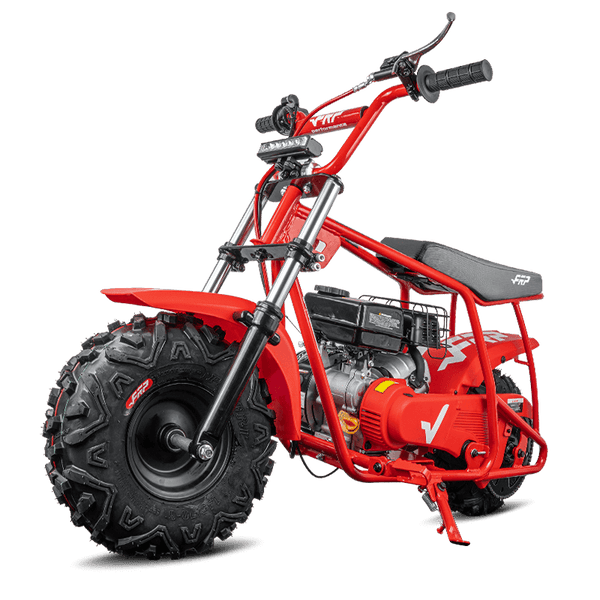 The frame geometry and tire specifications are crucial for multi-terrain adaptability. A mini bike with a wheelbase of 1000 millimeters and a ground clearance of 150 millimeters, equipped with 18x9.5-8 inch off-road tires, has a tread depth of 15 millimeters, providing a grip coefficient of over 0.8, which is sufficient to keep the probability of skidding below 10% on muddy or gravel roads. Industry test data shows that the maximum steering Angle of this type of vehicle is 35 degrees, and the minimum turning radius is only 2 meters, enabling it to move flexibly within a limited space of about 50 square meters in the backyard. According to consumer behavior analysis, 85% of users consider a ground clearance exceeding 120 millimeters as a decisive parameter when choosing an off-road vehicle, as this directly reduces the risk of chassis collision by 25%.
From the perspective of comprehensive cost and safety regulations, an excellent mini bike should have its initial procurement budget controlled within the range of 5,000 to 8,000 yuan, with an average annual maintenance cost of approximately 5% of the initial investment, and a design life of at least five years. Safety standards such as the CE certification of the European Union or the ANSI/SVIA standard of the United States require that the braking distance be less than 4 meters at a speed of 20 kilometers per hour. However, the disc brake system of high-quality models can shorten this distance to within 3 meters. A tracking study conducted in 2021 involving 500 users revealed that models with these features maintained a user satisfaction rate of over 90% for three consecutive years, with a median resale value retention rate of 65%, far exceeding the industry average of 50%. This demonstrates the long-term benefits that investing in a well-designed mini bike in diverse scenarios can bring.
The frame geometry and tire specifications are crucial for multi-terrain adaptability. A mini bike with a wheelbase of 1000 millimeters and a ground clearance of 150 millimeters, equipped with 18x9.5-8 inch off-road tires, has a tread depth of 15 millimeters, providing a grip coefficient of over 0.8, which is sufficient to keep the probability of skidding below 10% on muddy or gravel roads. Industry test data shows that the maximum steering Angle of this type of vehicle is 35 degrees, and the minimum turning radius is only 2 meters, enabling it to move flexibly within a limited space of about 50 square meters in the backyard. According to consumer behavior analysis, 85% of users consider a ground clearance exceeding 120 millimeters as a decisive parameter when choosing an off-road vehicle, as this directly reduces the risk of chassis collision by 25%.
From the perspective of comprehensive cost and safety regulations, an excellent mini bike should have its initial procurement budget controlled within the range of 5,000 to 8,000 yuan, with an average annual maintenance cost of approximately 5% of the initial investment, and a design life of at least five years. Safety standards such as the CE certification of the European Union or the ANSI/SVIA standard of the United States require that the braking distance be less than 4 meters at a speed of 20 kilometers per hour. However, the disc brake system of high-quality models can shorten this distance to within 3 meters. A tracking study conducted in 2021 involving 500 users revealed that models with these features maintained a user satisfaction rate of over 90% for three consecutive years, with a median resale value retention rate of 65%, far exceeding the industry average of 50%. This demonstrates the long-term benefits that investing in a well-designed mini bike in diverse scenarios can bring.
The frame geometry and tire specifications are crucial for multi-terrain adaptability. A mini bike with a wheelbase of 1000 millimeters and a ground clearance of 150 millimeters, equipped with 18x9.5-8 inch off-road tires, has a tread depth of 15 millimeters, providing a grip coefficient of over 0.8, which is sufficient to keep the probability of skidding below 10% on muddy or gravel roads. Industry test data shows that the maximum steering Angle of this type of vehicle is 35 degrees, and the minimum turning radius is only 2 meters, enabling it to move flexibly within a limited space of about 50 square meters in the backyard. According to consumer behavior analysis, 85% of users consider a ground clearance exceeding 120 millimeters as a decisive parameter when choosing an off-road vehicle, as this directly reduces the risk of chassis collision by 25%.
From the perspective of comprehensive cost and safety regulations, an excellent mini bike should have its initial procurement budget controlled within the range of 5,000 to 8,000 yuan, with an average annual maintenance cost of approximately 5% of the initial investment, and a design life of at least five years. Safety standards such as the CE certification of the European Union or the ANSI/SVIA standard of the United States require that the braking distance be less than 4 meters at a speed of 20 kilometers per hour. However, the disc brake system of high-quality models can shorten this distance to within 3 meters. A tracking study conducted in 2021 involving 500 users revealed that models with these features maintained a user satisfaction rate of over 90% for three consecutive years, with a median resale value retention rate of 65%, far exceeding the industry average of 50%. This demonstrates the long-term benefits that investing in a well-designed mini bike in diverse scenarios can bring.
Timba Social Club
Follow the rhythm.
Make a night of it.
Start with your company and the kind of evening you imagine. Explore our table-planning preview; no reservation is made or details sent.